Sunday, August 4, 2019

Two Story Tellers


Part 2 - (May 22 – May 24, 2019) – Hannibal, Missouri, Springfield, Illinois

Mid-afternoon the Professor and I departed Hannibal over the Mark Twain Memorial Bridge on Interstate 72 into the heart of the Land of Lincoln. Aside George Washington, Abraham Lincoln (1809 – 1865) is the United States’ most revered and loved President. Just behind state government, Lincoln is Springfield’s economic juggernaut. If you are interested in American history there is much to see in Capitol of Illinois.

Springfield was not always Illinois’ Capitol. Illinois was admitted into the United States in 1818. What is not well known, the state was settled eastward from the Mississippi River. As Illinois population moved east, in order to have a more central location, the Capitol was moved several times. Springfield was settled on in 1837, a result of legislative compromise. Earlier Capitols were in Kaskaskia and Vandalia. For chronological perspective, the City of Chicago was not incorporated until 1837.

Our next two days were spent scouting out and studying. We began our first full day at the Lincoln Home National Historic Site. The site consists of about four blocks that have been acquired and restored to the period when Abraham and Mary Todd Lincoln lived in Springfield with their sons. Touring the Lincoln home was informative and showed a glimpse into Lincoln’s love for his boys and the prosperous lifestyle the Lincoln’s enjoyed as a result of the Railsplitter’s success as a railroad lawyer and politician.

On one of the walls in the Lincoln home was a maxim that stirred me – “Love is the chain whereby to lock a child to its parent.” Post trip research indicates the quote is attributed to Abraham Lincoln.

Our next stop was Springfield’s most popular attraction the Abraham Lincoln Museum. This 21st century museum was constructed and is operated by the State of Illinois. The Museum tells the Lincoln story. The boy born in the Kentucky wilderness, orphaned, self-educated, and with character building and historic stops along his life’s highway to saving the Nation from itself (“a house divided against of itself cannot stand.”)

The Lincoln story is well told. The exhibits are educational and while simple are crisp. The use of technology is marvelous and presented at about an eighth-grade level, perfect for the many school field trips that travel to Springfield. Anchoring the extensive exhibits are two theatres, one showing a biopic, the other presenting an impressive electronic / holographic production.

Among the many well-known topics and Lincoln accomplishments covered chronologically in the exhibits (this is a long list!) are losing his mother, the role his step mother, Sarah Johnston, played in his life, his being largely self-educated, his early travels, becoming an Illinois State Representative, the decision to become a lawyer, his marriage to Mary Todd, becoming a United States Representative, the Lincoln Douglas debates, his Cooper Union Speech, his politically complex Presidential election, Commander and Chief during the Civil War, the Emancipation Proclamation, his Gettysburg Address, passing the Thirteenth Amendment, his Second Inaugural Address, the early death of two of his four sons, the assassination that made him a martyr, and predictably the focus on his return and burial in Springfield.

I especially found interesting the relationships Mary Todd and Abraham had with statesman Henry Clay. Mary was a native of Lexington, Kentucky also the home of Clay. The Todd and Clay families were closely associated in Lexington. Lincoln often sought advice and was mentored by Clay, particularly when he served in the U. S. House and Clay was in the U. S. Senate.

Historical note – Besides being in the U S Senate for thirteen years, Henry Clay served as Secretary of State four years in the John Quincy Adams administration, was elected to the U S Congress seven times, serving six terms as Speaker of the House (he was elected Speaker as a Freshman!), and served as a Commissioner to peace talks with the British to end the War of 1812 resulting in the Treaty of Ghent.

After the Lincoln Museum visit, we headed kitty-corner across the street to the Old State Capitol. The capitol now is solely a historical tourist attraction. The Old Capitol was vacated when the new Capitol building was completed in 1877. 

The Old State Capitol was the most engaging site we visited.The Old State Capitol sits on a mammoth square block. Unlike Iowa’s Old State Capitol in Iowa City that is pristine; Illinois “Old State” while adequately maintained begs for restoration. Given Illinois’ current state of finance, restoration though necessary is not likely soon.

The simple function of the building impressed me. On the first floor is the Governor’s Office, Secretary of State’s Office, Treasurer’s Office, and Legislator’s Library that appeared might have served as the Legislative Lobby. The fantastic tour guide pointed out a chess board that sat aside the broad reading table in the Library giving her the cue to tell us State Representative Lincoln was an avid chess player. The second floor contained the Supreme Courtroom, and individual legislative chambers for the Illinois House of Representatives, and the Illinois Senate.
 
Behind the Speaker of the House’s Chair is a copy of the Gilbert Stuart portrait of George Washington that now resides in the East Room at the White House in Washington, D. C. This important painting was taken and saved by First Lady Dolly Madison when escaping the burning White House torched by the British in 1814. While the Stuart in Springfield is a copy, it is important because it is the copy that overlooked Lincoln when he lied in State in that very room. More interesting is the Matthew Harris Jouett portrait of Marquis de Lafayette behind the presiding officer’s chair in the Senate chamber. I found it meaningful Illinois honored Lafayette. I failed to determine if the Marquis was a copy or the original.


The best of the best in Capitol the Elder was the life-sized sculpture of the “Little Giant”, Stephen A Douglas. The sculpture highlighted Douglas was physically a small man, five foot four inches in height. However, the sculptor portrayed him like a bear, tough and determined! Douglas was The Political Force in Illinois during his day. He served briefly as Illinois Secretary of State. Then served for two years as a Justice on the Illinois Supreme Court, four years as U S Representative, and fourteen years as U S Senator from Illinois. Douglas was the Democratic Party nominee for President in 1860.

Lincoln and Douglas had a history for almost three decades. During most of that time Douglas held the upper hand. Their history extending from when Lincoln served in the Illinois State House while Douglas was Secretary of State, Lincoln arguing more than two hundred and fifty cases before Associate Justice Douglas in the Illinois Supreme Court, Lincoln serving the Seventh Congressional District in the U. S. House while Douglas was the U S Senator from Illinois, and notably when Lincoln opposed Douglas for his Senate seat in 1858 resulting in the Lincoln-Douglas debates taking place. The debates were closely followed nationwide and fueled the flames of the national firestorm consuming the United States on the slavery question. Lincoln lost the election.

Historical note – Lincoln met Mary Todd when she had moved to Springfield to live with her sister. Mary had also been courted by Stephen Douglas.

The master Illinois Statesmen faced off again politically in the 1860 Presidential where Lincoln the Republican nominee (180 electoral votes) John C. Breckenridge the Southern Democratic nominee (72 electoral votes), John Bell the Constitution Union nominee (39 electoral votes), and Douglas the Democratic nominee (12 electoral votes.) contested for the White House. Lincoln advocated for Union, Douglas self-determination. Lincoln won the election.

Our last stop of the day was Lincoln’s Tomb at Oak Ridge Cemetery north and west of City Center. The tomb was built with private donations and is extensive. This historic site is operated by the Illinois Historic Preservation Agency. Lincoln is laid to rest beneath the tomb covered by ten feet of concrete a result of grave robbers attempting to unearth his remains in 1876. Also residing within the tomb are Mary Todd, and sons Tad, Willie, and Eddie. Son, Robert, is buried at Arlington National Cemetery.

Side bar – Robert Lincoln served as Secretary of War under President’s Garfield and Arthur and United States Ambassador to the United Kingdom under President’s Benjamin Harrison, and Cleveland.

On the night Lincoln was assassinated, Robert declined his Father and Mother’s invitation to accompany them to Ford’s Theatre, however when called, he arrived at his Father’s death bed. In an oddity of history Robert was present at both the assassination of President James Garfield and President William McKinley.


Inside the tomb are entrance and exit passageways to Lincoln’s headstone are statues of Lincoln. The gigantic headstone is surrounded by important National and State flags that define Abraham Lincoln. Behind and above the grave site emblazoned in gold is the quotation by Edwin M Stanton, “Now he belongs to the ages.”

The tomb’s exterior is capped by an obelisk 117 feet high and in front of the tomb is a mounted bust of Lincoln copied from the Gutzon Borglum statue of Lincoln in the U. S. Capitol.

Our second and last day in Springfield began with a tour of the Dana Thomas House. This twelve thousand five hundred square foot Frank Lloyd Wright house was constructed between 1902 and 1904. I particularly liked the profusion of windows, the library, and the entertainment gallery. It was the first home in Springfield with electricity. In many respects the Dana Thomas home is like other Wright homes, however what captured me was how easily the home blended nature and architecture.

Leaving the Dana Thomas House, we traveled twenty miles north to the Lincoln New Salem Historic Site. New Salem is the village where Lincoln lived from 1831 to 1837. The village was essentially abandoned in 1840, but the site was purchased in 1906 by William Randolph Hearst. Hearst later gifted New Salem to a local historical group. During the 1930’s the State of Illinois took ownership of the real estate and with assistance from the Civilian Conservation Corps restored the grounds to how it appeared when Lincoln was there.

The re-creation gives understanding to Lincoln’s personal development. While living in New Salem, Lincoln worked as a boatman, railsplitter, soldier, surveyor, postmaster, and general store owner. History records the store failed. Failed perhaps because Honest Abe spent too much of his time entertaining his customers, telling them stories, or talking politics. However, these diversions served him well. He developed thoughtfulness and empathy during this time. He enhanced his communication skills. Beyond being likeable and telling a good story he learned to be very effective in his use of parables to make legal and political arguments. Lincoln’s thoughtfulness and personality enabled his election to the State Legislature in 1834 and would lead to his uniting a divided nation. 

The historic village contains some twenty something farmsteads, homes, and commercial buildings. The buildings rest in a heavily wooded area; particularly on the day we visited the woods were ripe with ticks and mosquitos. 

Accompanying the village is an excellent visitor center that details Lincoln’s time in New Salem. The center’s content is more detailed and geared to students of history than the glamourous museum in Springfield.

Back in the Capitol City our last stop was at the Illinois State Museum. Frankly a disappointment. The Illinois history presented was modest at best and does not compare to the other rather less than great State museums I recently visited in Texas and New Mexico. If your interest is geology (mine isn’t), the Illinois State Museum does place emphasis on it. The museum does contain some interesting folk art.

Touring really isn’t touring without food. We interspersed our sightseeing and study time with quality meals at Saputo Italian Food, Obed & Isaac’s Microbrewery, and Mangia Bene. All are worthy. We capped each night off with a stop at Cold Stone Creamery, and lodged very comfortably, where else - The President Abraham Lincoln Hotel (Double Tree - Hilton ***).

When the Professor and I previously traveled to the Presidential Museums in Abilene, Kansas (Eisenhower) and Independence, Missouri (Truman) I recognized a strong character connection formed by their geographic proximity and commanding leadership skills (General of the Army and The Buck Stops Here!)

Spending this holiday weekend studying the history and lives of Samuel Clemens and Abraham Lincoln, I felt a similar connection. Undoubtedly their connection is a product of their shared geography, but more on the commonality of their wit,  shared personality traits, and their excellent communication skills.

Both Twain and Lincoln were self-made men. They both suffered the multiple losses of young children, and both were historically and notably great story tellers. History may judge it as an open question but living on the edge of the frontier and making personal connections has something to do with their story telling.

Throw in traveling with a great friend and seeing America's heartland, it was a great journey. 


Thursday, July 4, 2019

Two Story Tellers


Part 1 - (May 22 – May 24, 2019) – Hannibal, Missouri, Springfield, Illinois

On the Memorial Day weekend, I escaped with my exceptional friend, Professor Mydland, to America’s Heartland.

After overnighting in Iowa City, Iowa, our first stop was Hannibal, Missouri, the hometown of Samuel Langhorne Clemens (1835 – 1910). Clemens is known by his pen name, Mark Twain. Twain is considered the greatest author, humorist, and social commentator of 19th Century America.

We arrived at the Twain Interpretive Center and purchased our tickets allowing us to explore the historic properties. The Center was welcoming and included an overview and orientation of Hannibal’s favorite son. Included in the historic properties, we toured were the Mark Twain Boyhood Home, Becky Thatcher House, J M Clemens Justice of the Peace Office, and the Museum Gallery. Somehow, we missed the Huckleberry Finn House. The presentations were informative but not quite worthy of Twain’s greatness. The Museum however was impressive.

The first floor of the extremely clean and modern museum was focused on the stories and characters of five of Twain’s most popular books, Tom Sawyer, Huckleberry Finn, A Connecticut Yankee, Roughing It, and Innocents Abroad. The second floor was a catchall of various collectibles the Museum has acquired. Among them, I was attracted by the original Norman Rockwell paintings and a unique humorous photograph of Twain in cap and gown when he received his honorary Doctor of Letters degree from Oxford.

The Rockwell paintings were completed for a commission as illustrations for special editions published of Tom Sawyer and Huckleberry Finn. Rockwell’s artistic interpretations of Twain’s stories are wonderful.

Downtown riverside Hannibal looks like many other throwback tourist towns. Exposed underneath the 19th Century, small town taffy shop façade, is the foundation of Mark Twain along with a few peeks at his soul. The Hannibal young Sam grew up in was typical of small-town America at the time. Hannibal then had a population of about one thousand.

The considerable difference between Hannibal and other small towns was that American superhighway, the Mississippi River. The personalities and stories of the river boat travelers coming through Hannibal strongly influenced Twain. These characters and their stories on the edge of America’s frontier in 1850 captivated Twain’s soul and created his wanderlust. Absorbing the River would be his education. Foremost the River fostered his imagination!

Clemens’ father died when he was twelve and as a result, he formed a strong bond with his mother. His mother taught him compassion and he gained her sense of humor. A year later to help support the family he became a printer’s apprentice. At the age of fifteen he became a typesetter at his brother’s newspaper office where he also began writing articles for the paper. Remarkably typesetting gave him a unique perspective of words and their power.

Twain would go on to be a riverboat pilot, very briefly a member of the Confederate Army, a newspaperman, author, publisher, entrepreneur, and lecturer. He is best known as an author. William Faulkner, called him, “the Father of American Literature." Unknown by many was Twain’s love of science and technology.

Twain with his wife. Olivia, settled in Hartford, Connecticut. His personal life was often tragic with the loss of children and occasional financial failures. A result of his life’s tragedy, when employing his humor and wit, Twain never laughed.

Many of Twain’s works were biographical including “Roughing It”, “The Adventures of Tom Sawyer”, “Life on the Mississippi”, and “Innocents Abroad.” The great humorist also penned many other Classics including “A Connecticut Yankee in King Arthur’s Court”, and “The Prince and the Pauper.” Twain claimed his personal favorite was his biography of Joan of Arc. “Joan of Arc” took him eight years of research and writing to complete
. 
“If you want to look at America’s 19th century soul, Hannibal is without question, worth beholding.

Friday, April 12, 2019

March Madness


(March 22, 2019) – Figge Art Museum,  Davenport, Iowa


Gratefully, I scored tickets to first weekend sessions of hoops to the Big Dance in Des Moines. The first day’s elven-hour four game marathon was on Thursday. Qualifying for the Sweet Sixteen on Saturday were Michigan behemoths Michigan and Michigan State.


Des Moines’ Wells Fargo Events center was a comfortable venue with good sight lines, spacious, and with exceedingly efficient operations. Kudos to the Polk County Sheriff’s Department and the Des Moines Police for spectacular traffic control.

On the intervening Friday tournament day off, I trekked the one hundred seventy-five miles across Interstate 80 from Des Moines to Davenport, Iowa intent on checking out American artist and native Iowan, Grant Wood. My destination was Davenport’s Figge Art Museum the world’s largest repository of Wood’s art and his papers. They were a gift of Wood’s sister, Nan, who was the female subject in Wood’s Goliath masterpiece. and an icon of American art, “American Gothic.” Notably, “American Gothic” resides at the Art Institute in Chicago.

Recently, I have been studying American Regionalism and Wood’s works and have been looking forward to an opportunity to get to Davenport. Planning my visit, I read about Wood specifically and the current exhibits at the Figge museum. Even though I had viewed the museum’s website multiple times, I never focused on the museum’s building or its history.

Likewise, I’ve never paid attention to the Quad Cities (Davenport and Bettendorf, Iowa and Rock Island and Moline, Illinois) either. When traveling on I-80, I always marveled at the big river but never made a pit stop to check out the Cities south of the super highway. I am enamored by Mississippi River towns and without research was expecting a small-town museum that lucked into Wood’s significant art trove. I envisioned likely a restored mansion along the river. Something like the Children’s Museum on Summit Avenue in Fort Worth when I was young.

My Garmin delivered me to the museum, and I was astonished! Indeed March Madness.

The Figge Art Museum is imposing. It is fronted by a plaza with parking. while sitting on the backside is the mammoth Mississippi riverscape. Figge is large and modern. The museum designed by British architect, David Chipperfield, opened in 2005. This gorgeous structure is a key element of Davenport’s River Renaissance, revitalization. 

As a result of the new building, the former Davenport Art Museum was renamed the Figge Art Museum. Its moniker “The Figge.” The renaming was to honor Mr. and Mrs. V.O. Figge. The new building’s fundamental contribution for construction was from the V.O. and Elizabeth Kahl Figge Foundation. Mr. Figge had been a prominent Davenport banker.

My biggest surprise wasn’t the building but were the treasures inside.

I was ready for current exhibits described on the museum’s website, Animals in the Museum, Louis Comfort Tiffany: Treasures from the Driehaus Collection, but not the permanent collection. Among the galleries of the permanent collection were Haitian Art, Visions of the American West, The American Scene Regional Realism, and Frank Lloyd Wright.

The shocker are the gems exhibited in the Stanley Collection Gallery, “Legacies of Iowa.” These included works by Chagall, Picasso, Matisse, Marsden Hartley, Thomas Hart Benton among other masters.

Totally in my wheelhouse, was learning about the history of the Stanley Collection of such great Art. In the early 1960s the University of Iowa Museum of Art (UIMA) was established at the University of Iowa in Iowa City. The foundation of their collection were the many significant pieces of great art contributed by benevolent Hawkeyes and others.

In 2008 flooding overran the banks of the Iowa River that streams through The University of Iowa campus. In harm’s way was the UIMA. Almost the entire collection was successfully evacuated to Chicago for storage before the museum was compromised. Until the Stanley can be suitably rebuilt, under special agreement part of UIMA’s collection has been on permanent loan to the Figge; A silver lining for my visit.

There is much more I could say about the Figge but following are a few highlights.

The display of Grant Wood works and papers I traveled to see was limited.  Only four of Wood’s works were on display. The most dramatic was “Return from Bohemia”. The crayon, gouache, and pencil drawing include his lesser known self-portrait. “Return from Bohemia”, was intended to be the book cover for his never completed auto biography

The Realistic Regionalism gallery included works by American Regional Masters including Thomas Hart Benton and John Steuart Curry. Including Wood this triumvirate depicted the Midwest as prosperous, with rolling hills, rivers, and large fields with abundant crops. Several of the pieces had loose brush strokes associated with Impressionism, the foundation of early 20th century American Realism. Accompanying the featured Midwesterners in this galley were Illinois artist John Bloom, and American folk artist Grandma Moses.

The Figge’s headliner was the Louis Comfort Tiffany exhibit. Foremost I was impressed with the Davenport museum’s curatorial effort and the scope of this exhibit. The glass windows, lamps, and vases are exquisite. Tiffany is the gold standard in design and manufacture. The museum staff did a wonderful job in their display and conveying Tiffany’s history and methods. Fascinating!


Most Unique Painting, I Liked – A Fishing Harbor, 1683, by Matthais Withoos, Netherlands, 1627-1703. The first minute I saw this unique painting I was bewitched. A still life within a landscape.

The food - Worth mentioning was a quick stop at Whitey’s, the Quad Cities’ ice cream emporium, for a memorable turtle sundae – great salted pecans. On the return trip to Des Moines, there was supper in Iowa City near the Hawkeye campus. Near perfect rueben sandwich and a vodka tonic at St. Burch Tavern. $$


Overall a great March day in eastern Iowa on the River.


Wednesday, January 30, 2019

Newberry Library

(January 25, 2019) Chicago, Illinois


Last Thursday, I traveled on the Air Wisconsin commuter from Sioux Falls Joe Foss Field to "Butch" O'Hare International for a planned weekend with Jackie K., husband Jay, Will, Sara, and Aaron. If you are the least bit curious about World War II Flying Aces, check out the connection between, Foss and O'Hare. Both are Medal of Honor recipients though Foss was an American original. Joe wasn’t Teddy Roosevelt but does own one of the more public, diverse, and accomplished biographies of the twentieth century. 

My literally winter holiday to the Windy City was planned with free time on Friday to attack the Chicago Art Institute’s self-proclaimed top ten must see works. Surprisingly the top ten got side railed by a qunikydink of the federal government shutdown.

Two weeks prior to my holiday, my art mentor, Dr. Edward Welch suggested we investigate the portraiture of George Healy. Suggesting Healy resulted from seeing in the news, Healy’s well-known Lincoln portrait gazing over President Trump and the fast food feast he was serving to the National Champion Clemson Tiger football team on their White House visit.


George Healy (1813 – 1894) was a native Bostonian. At the age of eighteen he became a portrait artist. His art expressed his interest in human beings and “their” story whether they were beggars or kings. As a youth Healy was inspired by Marquis de-Lafayette whom he saw as a young child at the laying of the cornerstone for the Bunker Hill Monument on the 50th Anniversary of the Revolutionary War in 1825. In 1836 Healy travelled to Europe to study and work. After sixteen years he returned to America settling in Chicago.

A by-product of our study of George P. A. Healy was my discovery that the largest collection of Healy’s portraits lives at the Newberry Library in Chicago. The Newberry Library, a privately funded public access library hosts over forty Healy portraits including a similar arm chair portrait of Honest Abe, like the one at the White House. The Newberry Library is nestled on Chicago’s Gold Coast just west of Michigan Avenue.

The primary endowment of the library was from the estate of Walter Loomis Newberry. Walter became a Chicago resident in 1833, the year the town was organized. Newberry was a business partner of Lewis Cass (Secretary of War in the Andrew Jackson administration) and William Waldorf Astor (son of John Jacob Astor). The partnership were early investors in real estate in Chicago, Milwaukee, and Green Bay. Newberry was the first President of the Galena and Chicago Union Railroad, the first railroad in Chicago. The library was established as a research library. At the time of Newberry’s death Chicago already had a well-established public lending library.  

Any adult over the age of fourteen can obtain a library card by application and showing photo identification. The library card admits you to the reading rooms and research materials.

The library is stately and the furnishings, lighting, and quiet inspire study. The staff were helpful and extremely knowledgeable. To compliment my study of the artwork, I requested the biography of George Peter Alexander Healy, written by Marie De Mare, Healy’s granddaughter. The title “G.P.A. Healy, American Artist” was published in 1954. The introduction was penned by Eleanor Roosevelt.

The grand first floor includes, a welcome center (registration), coffee area, book shop, security checkpoints, and exhibit space. In the exhibit space are a set of display fixtures designated “From the Stacks” which contain diverse selections from the permanent collection. These exhibits are rotated frequently. There is a larger space consisting of three galleries for special exhibits that the library produces. Currently on display was “Melville Finding America at Sea.”

Topically Newberry’s collection includes, Medieval, Renaissance and Early Modern Studies; Maps, Travel and Exploration; Modern Manuscripts and Archives; Chicago and the Midwest; American Indian and Indigenous Studies; American History and Culture; Genealogy and Local History; History of the Book; Religion; Postcards; Performing Arts.

Lining the walls of the reading rooms and bookcases are various paintings, maps, and other presentations of cultural or historical nature. None of the works are presented in any way that draws special attention to them. Among the works on the three floors of reading rooms and offices are many of the Healy’s. The majority of the Healy’s were a gift to the library by the artist.

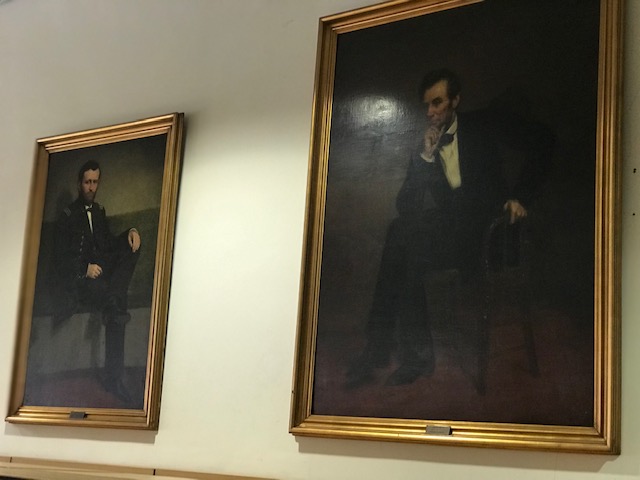
George Healy painted many famous people of his day including every President from John Quincy Adams to Ulysses S. Grant. Noted among the several Healy’s on display were wonderful portraits of Franz Litz, Walter Newberry, Otto Van Bismarck, Chester A. Arthur, and William Tecumseh Sherman among others. The two significant paintings of Lincoln and U. S. Grant were in an almost out of the way room near the end of the third-floor reading room above some bookcases.


The Lincoln portrait at the Newberry Library appears extremely similar to the White House painting though the White House painting is larger. Lincoln only sat for an hour for Healy one time about six months before he was assassinated. Healy completed the painting from his sketches as he did subsequent portraits of Lincoln.

Healy had always wanted to do a historical painting and he decided that his historical depiction would be the War Council of President Lincoln and his Generals, U. S. Grant, William T, Sherman, and Admiral David Dixon Porter on the steamship River Queen at City Point, Virginia about two weeks before the end of the Civil War. That meeting was the only time Lincoln met together with both Grant and Sherman. This famous painting is known as “The Peacemakers.” Today the painting hangs at the Defense Department at the Pentagon.


All of Healy’s portraits of Lincoln, Grant, Sherman, and Porter served as studies for “The Peacemakers.” When Healy conceived the idea of the "The Peacemakers," he had to arrange for a special sitting with Porter, whom he had not previously painted.

In 1869 Congress commissioned a painting of Lincoln for the White House. Healy sent his Lincoln portrait for selection, but President Grant turned it down. The Healy Lincoln was then purchased by Lincoln’s son, Robert Todd Lincoln, whose widow bequeathed it to their daughter who later gave it to the White House. The White House received it in 1939.


On a bitter zero- degree day by the Lakeshore in Chicago I found refuge at The Newberry Library. It was a fun little discovery and I had a great time.  


Tuesday, August 7, 2018

Three Days - Three Men Part 3


Walton – The Walmart Museum is located in Sam Walton’s first store on the town square in Bentonville. While extremely informative and historically accurate, the museum is produced like Disneyland and clearly the product of Walmart’s Public Relations maestros. The museum has excellent displays and tells the story of Walmart and Sam Walton. Opinions on Walmart and Sam Walton’s leadership are controversial and vary widely.

My opinion is positive, and after viewing his story through the glowing corporate PR halo remain positive.

Samuel Walton was born in 1918 at Kingfisher, Oklahoma. His father farmed there for about five years after Sam’s birth. The father then relocated his family several times after taking a job as a mortgage broker and later as a fore closer on farms during the Great Depression. In the eighth grade Sam became the youngest Eagle Scout in Missouri history. The family eventually settled at Columbia, Missouri where Sam graduated high school.

He attended the University of Missouri on a ROTC scholarship supplemented by waiting tables in a dormitory dining hall. He graduated in 1940 with a degree in Economics. Sam was very popular in college and upon graduation, his class elected him permanent president of their class.

After graduation he went to work for J C Penney stores as a management trainee in Des Moines. In contemplation of Army induction in 1942, he took a temporary job at a DuPont munitions plant near Tulsa. When he entered the Army, he was assigned to the Intelligence Corps where he supervised security units at aircraft plants and prisoner of war camps, stateside. Sam married Helen Robson in 1943. They would have four children, one girl and three boys. Sam Walton was discharged from the Army in 1945 with the rank of Captain.

Walton started his first store in Newport, Arkansas. The Ben Franklin five and dime was a franchise store. Sam was an excellent business manager and great merchandiser. The store was well stocked always having what his customers wanted at the best price. When his short-term lease came due for renewal, his obvious success encouraged his landlord to ask for an exorbitant rent increase. After some negotiation, the landlord purchased the business lock, stock, and barrel.

Pocketing a quick profit, Sam purchased the Ben Franklin franchise for Bentonville, Arkansas. This was the first of sixteen Ben Franklin stores he would own. The second Ben Franklin was opened in 1952. In 1953 he purchased his first airplane. The plane would be a critical, tool, giving him the ability to be in his stores more often.  Sam also used the plane to scout out future store locations.

During this early business expansion period Sam proved to be an excellent manager. He was adept in hiring skilled store managers and headquarters staff, allowing him to spend time in his stores motivating and listening to the concerns of two important groups: his Customers and his Employees. Walton required daily sales reports from each of his stores detailing sales volumes and the items sold. These attributes would prove to be key elements of his phenomenal success.

Walton’s first discount store was opened at Rogers, Arkansas in 1962. At the suggestion of the store manager, Bob Bogle, the store was named Walmart. By 1967 Walmart had twenty-four stores and annual sales of almost thirteen million dollars.

The catalyst enabling this country boy to become the world’s largest retailer was a class conducted for prospective customers by IBM. At these classes, International Business Machines demonstrated the capabilities of their data processing equipment for retail sales management. Sam Walton immediately recognized the value and the potential computers and technology would have on retailing and distribution management.

On his return from IBM school, he hired five programmers away from IBM to implement a data processing system and strategy. Walmart would become the leader in adopting technology. In addition to the main frame computer, Walmart was the first retailer to use point of sale systems (faster and more accurate checkout) and satellite communications linking voice, data and video. Sam Walton understood future success depended on data and logistics.

Growth Timeline - Walmart was listed on the New York Stock Exchange in 1972 when they had fifty-one stores and sales of seventy-eight million dollars. By 1980 they reached the sales of one billion dollars, two hundred and seventy-eight stores, and twenty-one thousand employees (Walmart refers to employees as associates.) Sam Walton died in 1992. At the time of his death, Walmart had one thousand, nine hundred and twenty-eight stores, and three hundred and seventy-one thousand employees. Shortly thereafter, in 1993 Walmart had their first one-billion-dollar sales week.

This past fiscal year (2018) Sam Walton’s little store reported annual sales of five hundred billion dollars, over eleven thousand, seven hundred stores operating in twenty-eight countries (over six thousand in the United States), over one million two hundred thousand employees, and serving over two hundred and seventy million customers each week. Walmart also has a vibrant if not dominant online presence.

Walmart’s PR emphasized that Mr. Sam, as he was known, prided himself or raising the standard of living for customers while lowering their cost of living; EDLP (Everyday low prices – Always.)  

Walmart’s success brought enormous wealth to the Walton family. They have accepted social responsibility and been generous in sharing their wealth. Walmart and the Walton Family established large foundations that support public and charitable activities. Walmart also is a leader in corporate disaster relief, mobilizing their resources quickly for the cause of public safety.

Crystal Bridges Museum of American Art exists because of the dedication and generosity of Helen and Sam Walton’s daughter, Alice.  Alice Walton, the richest woman in the world and the richest Texan, interest in American Art was cultivated by Ruth Carter Stevenson. Mrs. Stevenson was the driving force of the Amon Carter Museum of American Art where Alice Walton served as a member of the Board of Trustees for eleven years.

As Alice’s interest in American art developed she began acquiring the work of American masters. Logically she with the assistance of the Walmart Foundation and her family foundation constructed the beautiful and fabulous facility in Bentonville where it is stocked with Alice Walton’s collection. The building is spectacular!


Crystal Bridges is set in the woods and designed to be restful. When I arrived on Saturday morning it was anything but restful. The museum was packed - overcrowded - and loud! Admission is sponsored by Walmart, though admission to special exhibits carries an admission charge. I made my way through the galleries too quickly, as I could hardly hear myself think.

There were important pieces by Thomas Cole, Albert Bierstadt, Martin Johnson Heade, John Mix Stanley, Thomas Moran, Fredric Remington, Frederic Edwin Church, William Trost Richards, William Merritt Chase, Winslow Homer, John Singer Sergeant, and more.  I was not able to study or enjoy the art. Really Too Bad!

I escaped to a special exhibit: The Beyond Georgia O’Keefe & Contemporary Art. Admission was ten dollars though I was comped because of my Veteran’s status and thanked by the ticket seller for my service. The O’Keefe exhibit foremost was quiet, so I enjoyed it.

Gathered were important O’Keefe pieces from primarily galleries in the United States. O’Keefe’s use of the effect of light and her ability to work between reality and abstraction is truly a work of art (brilliance). There were about thirty of her works on display along with selected pieces from other artists the curator believed expanded on O’Keefe’s inspiration.  


The O’Keefe exhibition signature piece was “The Beyond.” Truly unique, “The Beyond” was captivating. O’Keefe painted it after she had lost her primary vision and using only her remaining peripheral vision.

Two years was a long time to wait to get to Crystal Bridges, and I would love to return but will have to understand how to assure a far calmer day. It could be a long time.

Wednesday, August 1, 2018

Three Days - Three Men Part 2


Rogers – The Will Rogers Museum at Claremore, tells the story not of the most famous but the most beloved man of his time.

William Penn Adair Rogers was born at Oologah, Oklahoma in 1879 to a prominent Cherokee family in Indian Territory. Oologah and Claremore are located in Rogers County, named for his father, Clem Rogers a rancher and local leader. Clem Rogers was a proponent for Oklahoma Statehood and in 1907 would be the oldest delegate to the Oklahoma Constitutional Convention before Oklahoma’s annexation as our forty-sixth state.

Variety was the essence of Will Rogers’ life story. He attended Indian boarding school in Missouri and later attended the Kemper Military Academy. While at Kemper he read the New York Times every day. Though a good student he dropped out of school in the tenth grade returning home to become a ranch hand.

When he was twenty-two, with a friend he left the Rogers ranch to start his own ranch in Argentina. The enterprise failed and not wanting to return home Will set out for South Africa to break horses for the British Army during the Boer War. Fortuitously the war ended shortly after his arrival. He quickly took a job with a circus / wild west show as a trick rider and roper. He named his act The Cherokee Kid. From South Africa his wanderlust took him to Australia.

In 1905 he landed in New York City and became a Vaudeville performer doing rope tricks, telling jokes, and talking about current events. Rogers was engaging with a dry sense of humor. Will possessed an everyman persona, was extremely engaging, He was a natural entertainer.

Will married Betty Burke in 1908 in Claremore. Rather than settling down in Oklahoma, the couple returned to Broadway where in 1915 he gained notoriety as a headliner in the Ziegfeld Follies. He starred and performed for Florenz Ziegfeld for seven years. In 1918 Samuel Goldwyn recruited him to act in silent films. Will Rogers quickly became a big star. America loved him. In many of his films he played himself. Amazingly the movie star performed in seventy-one films (fifty silent and twenty-one talkies.)

Knowing a winner when they saw one the New York Times first enticed Will to write a column for them. Rogers stories and commentary on current events were carried in four hundred newspapers and read by forty million people (in 1930 America’s population was one hundred and twenty-three million.) Will also became a radio personality with his own radio program from 1929 – 1935.


Rogers died in a plane crash with noted aviator, Wiley Post in 1935 at the age of fifty-five. During his life he excelled at many occupations: Indian Cowboy, Ziegfeld Follies, Newspaperman, Radio Pundit, Movie Star, and Philosopher.


The Claremore museum built shortly after his death was funded in part by citizens of Oklahoma in honor of their most favorite son. Near his grave is the statue, “Riding into the Sunset”, of Rogers astride his horse Soapsuds. The sculptor was Electra Waggoner Biggs. Electra’s other castings of “Riding into the Sunset” are at the Will Rogers Coliseum in Fort Worth and Texas Tech University in Lubbock, Texas.

The Museum is physically too big for what is on display - but not for the man who is memorialized. Beyond the display cases and the repetitious plethora of painted portraits the story is best told through the filmstrips and Will’s movies being shown in the main theatre, galleries, and nooks.


My biggest treat while there was meeting one of the costumed docents, Andy Hogan. Andy is pretty close to Will Rogers doppelganger. He was dressed like Rogers hat to boots. He talked like Rogers and he did rope tricks. Foremost Andy was a Will Rogers encyclopedia. It was like talking Jewish geography for a couple old guys from Cowboy Country. Obviously, we talked about Rogers, we talked about the Gilcrease, we talked Fort Worth, we talked Waggoner Ranch, we talked Big 12 Football. No matter what the subject Andy knew about it!

Rogers was the right man at the right time. America needed him through the Great Depression. While he dabbled on the edge of politics; “I am not a member of any organized political party. I am a Democrat!” he was an Everyman. When twenty percent of Americans were unemployed, he made them laugh when they needed hope, reassurance, and laughter.

The two quotes, I liked best from this homespun philosopher were: “Tomorrow is a better day.” and “My forefathers didn’t come over on the Mayflower, but they met the boat.”

Will Rogers most famous quotation was, “I never met a man I didn’t like.” I came away from his memorial thinking, every man who saw or heard Rogers, liked him!


Three Days – Three Men Part 1


(July 19, 2018) Tulsa, Oklahoma

(July 20, 2018) Claremore, Oklahoma

(July 21, 2018) Bentonville, Arkansas


Two years ago, I promised myself to visit Crystal Bridges Museum of American Art in Bentonville, Arkansas. Never seemingly able to find a time, yet determined, I finally soloed to Northwest Arkansas by way of Oklahoma’s Green Country between the Osage Hills and the Ozarks.

In addition to Crystal Bridges, I planned to see the Gilcrease Institute of American History and Art in Tulsa, the Will Rogers Memorial Museum in Claremore, the Walmart Museum in Bentonville, and a quick stop at Pea Ridge Civil War Battlefield east of Bentonville. I expected to see great art but came away more fascinated by the stories of three quite different exceptional men.


Gilcrease - I always thought of Thomas Gilcrease as just another what Texans called BOM (Big Oil Money). Gilcrease was a lot more than BOM! William Thomas Gilcrease was born in 1890 at Natchitoches Parish, Louisiana to an Irish immigrant father and a mother of Creek Indian ancestry and a member of the Osage Tribe. Soon after Thomas’ birth the Gilcrease family moved to the Creek Reservation where his father operated a cotton gin in nearby Mounds, Oklahoma.

Thomas being one-eighth Indian was enrolled as a member of the Osage Tribe. A result of the 1887 Dawes Allotment Act, in 1899 young Thomas was allotted one hundred sixty acres of land about 20 miles south of Tulsa. In 1905 the Glenn Pool oil formation was discovered, and Tom Gilcrease became a millionaire at age eighteen. Gilcrease had little formal education, however he proved to be a brilliant oilman. Unlike so many other native Americans he was not swindled out of his riches. Gilcrease would become one of the wealthiest men in Tulsa, then known as the “Oil Capitol of the World.”

Gilcrease business acumen and financial magic did not carry over to his family life. His two marriages failed, and both ended relatively quickly in divorce. Notably his second marriage was to the first Oklahoman to become Miss America (1926). Gilcrease Oil first maintained their principal office in San Antonio and later located in Tulsa. Gilcrease often traveled to Europe for business and pleasure. During his travels he became interested in art and was inspired to learn more about it and began collecting. His fortune provided him with an abundance of economic firepower and once he got the acquisition itch, he scratched intensely.

American art and American history were his dominant interests. His collection consists of painting and sculptures by primarily nineteenth and twentieth century American artists, an extensive collection of native American artists, thousands of native American artifacts including beautiful pottery, and Americana including many historical documents. In sum his collection includes nearly five hundred thousand pieces. The museum houses one of the two known hand-written copies of the Declaration of Independence. This alone is priceless.  The other resides in our National Archives in Washington, D. C. (see movie “National Treasure”.)

What distinguishes Gilcrease from other prominent collectors was his intense study of his collection. More than art appreciation, real understanding. Many people of wealth have large collections but few shared Gilcrease’s level of attachment and appreciation. The other aspect of Gilcrease that impressed me was his sponsorship of native American artists. His generosity allowed them to develop and guaranteed them a market for their works until they became established.

Mr. Gilcrease donated his entire collection and the museum real estate to the City of Tulsa. The Gilcrease Institute is operated by the University of Tulsa. In the early 1950s when the price of oil became severely low Gilcrease Oil experienced severe cash flow problems. In order to meet his financial obligation Gilcrease considered selling some of his treasured art. Fort Worth City Father, Amon Carter, offered Gilcrease over two million dollars for significant parts of the collection. Gilcrease though refused, telling Carter selling would be like deciding which of his children to part with.

The City of Tulsa came to his rescue, not wanting to lose the presence of significant and unique art in their community. To help Gilcrease get through his rough spot, the City passed a bond issue to pay the Gilcrease debt. A public bond issue to bail out a private business? Politically unbelievable! Gilcrease repaid the City from museum operations.

During my visit, on display were photographs by Blake Little of Gay Rodeo, still photographs from ’The Big Trail” (1930), John Wayne’s first credited motion picture role, several large galleries of masterworks from the Gilcrease collection, and a wide assortment of selections from the large native American collection. 


My favorite works were the John James Audubon painting of “Wild Turkey”, the massive and spectacular “Grand Canyon” by William Robinson Leigh, and the Abraham Lincoln death mask and castings of the Rail Splitter’s colossal hands. Among the native American artists, I particularly liked Woodrow Wilson Crumbo. The native American exhibits provided new curiosity and fuel for study of both the Taos Eight and Oklahoma’s Kiowa Five artists.