Saturday, April 22, 2017

Busman's Holiday


(April 20, 2017) Council Bluff’s IA, Omaha, NE


Thursday I played hooky. I forwarded my work telephone and headed with my friend and art mentor, Dr. Ed Welch to Omaha, and Council Bluffs for a day trip to a familiar historic site and a first class art exhibit.  


Our first stop for me an encore was at the Historic Dodge House in Council Bluffs. Grenville Melin Dodge is one of those historic figures you have never heard of, though you have seen his picture. In the famous picture celebrating the completion of the Transcontinental Railroad at Promontory Summit, Grenville Dodge is one of the men shaking hands in front of the two railroad engines.


Grenville Dodge was one of those men in the second half of the 19th Century who exemplified America’s manifest destiny. He was successful in the military, politics, railroad building, and as a Wall Street financier.  

Dodge’s highlight reel includes service in the Civil War obtaining the rank of Major General and distinguishing himself at the Battle of Pea Ridge and the Siege of Atlanta. As a railroad builder, besides being the Chief Engineer of the Union Pacific Railroad, Dodge built and or financed several railroads including the Texas & Pacific, and railroads in Europe, South America, and Russia. Dodge behind the scenes essentially controlled the Republican Party in Iowa for over fifty years. Dodge and his brother Nathan (N.P.) Dodge were major developers in Omaha and Council Bluffs and had significant business interests there in banking and real estate. 

The beautiful Dodge House was built in 1869 at a cost of $35,000. It has been painstakingly restored with much of the original furniture. The home tells the Dodge story. A significant factoid is that five Republican Presidents dined at the General’s home.

In addition to the Council Bluff’s home, the General lived in a private rail car and maintained a home in New York City. Dodge was a close associate of General and President U S Grant. When Grant’s Tomb was dedicated on New York City’s Riverside Drive in 1897, Dodge was Grand Marshall of the Parade at the dedication.


After our history lesson and a quick lunch at The Cheesecake Factory Ed and I reached the Josyln Art Museum to see the current exhibition Wild Spaces, Open Seasons, Hunting and Fishing in American Art.  Admission was a modest $10.

This honestly first class exhibition was a look at American art's fascination with hunting and fishing. The exhibit was curated by the Joslyn Art Museum, my Mother Ship – The Amon Carter Museum of American Art (Fort Worth) and the Shelburne Museum (Shelburne, Vermont). Wild Spaces will be traveling to Cowtown this autumn.

Relating to hunting and fishing throughout the exhibit the artwork emphasized several themes:

Men hunted to support themselves and their family

Hunting and fishing was an outdoor sport of the leisurely upper class

Hunting could be a hazardous adventure. 

Hunting portrayed mythical stories

Hunting transformed a young nation into an industrial power

The vanishing wilderness

There were many art pieces, primarily oil on canvas and sculpture demonstrating and reinforcing these themes. Included were many objects by some of America’s greatest artists representing many genres. Some important major pieces were on display.

A few of the artists shown were Thomas Eakins, William Merritt Chase, Rockwell Kent, Thomas Cole, Albert Bierstadt, George Caleb Bingham, Martin Johnson Heade, William R Leigh, Alfred Jacob Miller, Frederic Remington, John Singer Sargent, Charles M Russell, N C Wyeth, Marsden Hartley, Doug Manship, William Hartnett, August Saint-Gaudens, and Edward S Curtis.

I was introduced to a new wildlife artist, Arthur Fitzwilliam Tait who I liked and hope to learn more about.

One sculpture that particularly appealed to me was Diana by Saint-Gaudens. The sculpture was a casting of the original designed for atop the tower on the original Madison Square Garden.


One point the exhibition made that struck me was a quote attributed to  Ralph Waldo Emerson who “encouraged Americans to relate to the land as a means of cultivating a national identity.”

Our road trip was an enjoyable escape. 


Sunday, April 16, 2017

Mother of All Mothers


(April 10, 2017) Chicago, Illinois

Our family spent last weekend celebrating granddaughter Sara Kulesza’s Bat Mitzvah in Chicago. It was wonderful spending time with family and close South Dakota friends. Having time on Monday before Seder on the first eve of Passover, Harry and I headed downtown for a drop in peek at the massive Art Institute of Chicago.

The Art Institute’s current featured exhibit is of James McNeill Whistler’s famed painting “Arrangement in Gray and Black No. 1” (1871). Universally known as “Whistler’s Mother”, it is one of the world’s most recognizable paintings. The exhibit was Mother’s third trip to Chicago; her last stay was at the Art Institute sixty years ago. She usually resides with her owner the Musée d’Orsay in Paris.

James McNeill Whistler (1834 -1903) was born in Lowell, Massachusetts. It is slightly ironic his grandfather, Captain John Whistler, founded Fort Dearborn in 1831 in what is now Chicago. Fort Dearborn was located where now is Michigan Avenue and Wacker Drive, a few blocks north of the Art Institute. Whistler who was an expat most of his life and never resided in Chicago considered himself a son of the City.

Whistler’s parents wanted him to study for the ministry but he was not interested. Instead Whistler was accepted to West Point. His career was lackluster and near the end of the three-year course of study, after much leniency, Superintendent Robert E. Lee dismissed him. As a Cadet he did distinguish himself as a draftsman and cartographer. Leaving West Point, Whistler moved to Washington, D. C. where he went to work for the U. S. Land Survey. Later following his art muse, Whistler moved to Paris and later settled in London.

As an artist, Whistler is best known as a painter and printmaker. His painting employed resolved brush strokes, while his printmaking technique was very sensitive and his lines precise.


Surrounding the masterpiece is an interesting story. Whistler’s mother was living with him in Chelsea at the time of the painting and agreed to be the model for his composition. Originally she stood in his living room for the portrait. However the physical demands of posing proved to be too strenuous for Mom. Consequently the painting was recomposed with her sitting.

The result was the painting we know today capturing and embodying some of the best qualities of motherhood at the time; “stoic rectitude and frugality.”

The curated exhibit was contained within one gallery yet exhibited to give context to the Grand Centerpiece and the Artist. Associated pieces in the exhibit that I particularly liked were:

       Portrait of Whistler (1869) by Walter Graves
      
       Self Portrait of Whistler (1871 – 1873) chalk on pale brown paper

      Portrait of Arthur Jerome Eddy (1894) by James McNeill Whistler – oil painting done in Chicago during the Columbian Exposition

     Black Lion Wharf Print (1859) by James McNeill Whistler – part of the Thames set. This is the small print seen in the background in “Whistler’s Mother”.

With a little time left in our Art Institute stay, Harry and I attacked the Field McCormick Galleries of American Art. I walked into the first gallery and was blown away by James Earl Fraser’s (of buffalo nickel fame) “End of the Trail.” It is little known that Fraser grew up in Mitchell, South Dakota. Residing next to the famous sculpture were castings of Frederic Remington’s “Bronco Buster” and “Coming through the Rye.” Seeing these three was worth the price of admission ($24 adult, $20 senior).

Just walking through there were so many museum worthy pieces to see. There were works by favorites John Singleton Copley, Martin Johnson Heade, Thomas Cole, Thomas Moran, August Saint-Gaudens and many many others.

One particular sculpture I was attracted to was a sculpture of Abraham Lincoln by Daniel Chester French (designer of the Lincoln Memorial.) Remarkably the Lincoln Centennial Commission of Nebraska commissioned the sculpture but they did not complete the subscription payments allowing the sculpture to find new owners.


It was interesting to learn that Chicago had been a starting or “dropping off” point for many Western artists in the 19th and early 20th centuries. The Art Institute’s American collection is extensive and alone worth a visit.


Friday, January 13, 2017

Yes to CES


(January 6, 2017) Las Vegas, NV

Susan and I were off to Las Vegas for some family time with our kids. Jackie was in town for meetings with clients and vendors at the Consumer Electronics Show. It was a great couple of days together with Jackie and Harry.

Friday I captured a pass to the Big Show and along with the other 185,000 world travelers scrutinized the latest, greatest, and looked at the future. 185,000 is a big number and the show is Goliath. Strangely by comparison it did not seem larger than the now over 40,000 “Shareholders” who crowd into the comparatively tiny Century Link Center in Omaha for Berkshire Hathaway’s annual meeting. Worth considering is the attraction of acres of new technology and glitz in LV is competing with Warrant Buffet’s Woodstock of Capitalism where Warren and Charlie Munger are  teaching and preaching for just about four hours!

My impression of CES was strikingly different than when I attended in 2014. Three years ago I was WOWED by all the technology, the glitz, and the Internationalism. This year I was touched by the economics of it all.

In those respects this year was not that different. I wasn’t moved by bigger video monitors at faster speeds with telescopic like resolutions, smarter homes, more personal tech, or more cyber security.

The focus of the technology this year was on how all of this fits together in our rapidly changing and connected lives. It is what the sages are calling the “Internet of Things”. Throw in robotics and we have embarked into the Brave New World.

Three years ago the hot “thing” was accessibility to devices by Apps, this year devices require connection by VAPA (Voice Activated Personal Assistants).

The “buzz” was about Virtual Reality (VR), Augmented Reality (AR), Artificial Intelligence (AI), and how it affects business, education, and entertainment.

My one-day at the Show only allowed me to walk through the portion of CES at the 1 million plus square foot Las Vegas Convention Center. I did not make it too the Sands Convention Center or other allied venues.  A majority of the exhibits (by space) were smart cars and smart homes.

My take away is Consumers want convenience and ease of use, not complicated applications. Developers understand this.

Simply put, the technology did not blow me away but the impact the tech has on our economy and its future did! Two-thirds of our economy consists of expenditures related to automobiles and housing. Traveling through the CES exhibits demonstrated this.


The economic shocker exhibit was seeing automobiles being built with 3D printing. Beyond robots this is a game changer for our most important industry. It changes manpower and capital requirements. Not only are cars going to be driverless but they are going to be made solely by computer driven printers with the exception for now of forged pistons. (Check out the Video)

https://www.youtube.com/watch?v=UVqDeCmKDSQ&t


3D Printing of cars changes foreign trade and perhaps will lower costs significantly. This will impact not just American jobs but labor demands in Canada, Mexico, and China as well.

On a personal note – I met the daughter of my friend, Jim Woster. Sara Woster headed the public relations efforts at CES for Mobileye. The fifteen minutes with Sara were quite enlightening. Sara who lives in Brooklyn with a retreat in northern Minnesota was very professional, well informed and engaging. Jim rightfully is very proud of her.  It is wonderful to see South Dakota kids making it in the big world out there.

Mobileye is an Israeli tech company founded in 1999 that developed the software which “supports safety and convenience related ADAS (Advanced Driver Assistance Systems) functions from a single camera sensor.” Mobileye is a vendor to twenty-five international automobile manufacturers and in 2016 had sales of an estimated $350 million.

For a far better review of CES 2017 here is a Professional Analysis.

Las Vegas provided other get away diversions as well:

     Good luck at the games - Harry and I together made three points followed by six points at the Craps table! 


     On Saturday night we caught a show at the SLS Hotel and Casino (formerly the Sahara). We saw the best stand up comic in America today, Dana Carvey. Carvey was reunited and perfroming with Jon Lovitz. Carvey’s impersonations were fantastic and I haven’t laughed so hard ever! (even at my own jokes – my family understands this.)

     Outstanding Louie Salad with wild lump crab meat at King’s Fish House (a California restaurant chain) in the District in Henderson 
   
    The World’s Greatest Club Sandwich! (turkey carved and sliced from the bone) at Grand Luxe Café at the Palazzo

     Watching the Packers dismantle the Giants on Sunday at the Golden Nugget.


It was hard to leave Nevada’s fifty degree temps for Zero back in Dakota, but it was a good time. 

Thursday, November 10, 2016

Herbert Hoover Presidential Library & Museum


(October 7, 2016) West Branch, Iowa


On this beautiful fall weekend, Susan and I escaped to eastern Iowa for the wedding of one of our closest friends' son in Iowa City. We set out a day ahead of the wedding festivities to do some touring. Our first night was in West Des Moines, Iowa. On Friday morning, we toured The Herbert Hoover Presidential Museum and Library in West Branch, Iowa.

The Hoover museum was built before the era of federal General Services Administration funding for Presidential Libraries. The facility is unassuming compared to the post federal funding recent Goliaths.

We arrived at the exhibits and archives mid-morning.

The Museum is a Tribute to Herbert Hoover and has well displayed and interesting exhibits. This stop along the I-80 corridor is two hours well spent.

Our Museum visit completed, we traveled back west to the Amana Colonies for lunch. We settled on the Ox Yoke Inn in Amana, Iowa. The food was wholesome but as usual I made a bad menu choice. After lunch we checked out the nearby tourist shops with interest. Out sole purchase was a very nice blanket for grandson Will at the Amana Woolen Mill.

What follows is my interpretation of a great man and a very well told story.

Like “A Tale of Two Cities”, it is the story of the American President, who during his lifetime, at one time was the most popular and well respected person in America and at another time the most hated and despised. Despite these disparate perceptions the 31st American President was always consistent to his conservative yet progressive values and Quaker upbringing.

Herbert Clark Hoover was born August 1874 to Quaker parents. His mother was from Canada and his father, a blacksmith, was an Ohioan. At age nine Hoover was orphaned and ultimately lived with an Uncle and his family in Oregon. His Uncle was a physician and businessman.

Hoover who was called Bert, adopted Quaker piety always strived to get ahead and improve himself. His Uncle by instruction and personal example imbued into his nephew a strong work ethic. Hoover did not attend high school but worked in his Uncle’s real estate office and attended a business school at night learning mathematics, bookkeeping, and typing. Hoover became a strong believer in Self Reliance.

Bert entered Stanford University in 1891. He served as the business manager for the football and baseball teams. Under his  administration both sports were profitable. Bert received his degree in geology in 1895 a member of Stanford’s inaugural graduating class.

Hoover was a proponent of the Efficiency Movement, which became popular in the early 20th Century. The movement sought to adopt best practices to identify and eliminate waste in society and the economy.

He began his career working as a mining engineer in Nevada City, California and after working at several mines in California was hired variously by several British mining firms for assignments in Australia and later China. Hoover was so competent he received an ownership interest in the Bewick, Moreing, and Company (mining company). Some of Bewick’s mines provided Hoover enormous income even after his death. At age twenty-seven Hoover was a millionaire. Reportedly he received the largest annual salary for a person his age among any other known person. In 1908 Hoover started his own company and owned profitable companies on every continent except Antarctica.

Hoover became a Trustee of Stanford University in 1912, a position he held until his death in 1964. Hoover was the founder and benefactor of the Hoover Institution, founded in 1919 as a policy think tank. The Hoover Institution is closely associated with Stanford.

During and after World War I he served as the Administrator of the U S Food Administration providing humanitarian relief to war torn Europe. Hoover led efforts saved Belgium from famine. Among the most unusual and beautiful artifacts in his museum are the burlap flour sacks Belgium woman embroidered and sent to Hoover in thanks.

Hoover was recognized as the “Boy Wonder”, the Great Engineer”, the “Man Who Gets Things Done”, the “Problem Solver.” In 1921 President Warren G Harding, selected Hoover to be Secretary of Commerce. During the Roaring ‘20s Hoover became a symbol of America’s success. He championed the building of better roads, street and highway safety, electrification, and the adoption of Standardization. President Calvin Coolidge put Hoover in charge of mobilizing and coordinating the relief efforts in response to the Great Mississippi River Flood of 1927.

In 1927, Coolidge surprisingly announced (from his summer vacation in the Black Hills of South Dakota) he would not run for a second full term in the 1928 election. Hoover quickly became the leading Republican candidate to replace Coolidge. He was elected defeating New York Governor Al Smith in a landslide 21 million to 15 million popular votes and 444 to 87 in the Electoral College. From a political perspective Smith supported repeal of Prohibition, while the Quaker Hoover opposed repeal. Hoover and John Kennedy are the only two Presidents who refused a Presidential salary, though JFK directed his to charity.

Hoover’s legacy and Presidency was framed by the Wall Street Crash, the Great Depression and subsequent Massive National Unemployment. Hoover who strongly believed in self-reliance implemented some Public Works Projects to create employment and economic activity. I was shocked to learn Hoover was a proponent of the Davis-Bacon Act that requires payment of prevailing local wages on public works projects. He reluctantly approved the Smoot Hawley tariffs and believing in a balance budget raised taxes. The tariffs had the effect of increasing unemployment as the economy spiraled downward. Near the conclusion of his Presidency (July 1932) the Bonus Army marched on Washington. The (mis) handling of the nearly 40,000 persons encamped in the Capitol City and violence that occurred during their demonstrations caused an adverse onus on Hoover’s reputation.

Factoids I liked:

President Hoover established the first Presidential Retreat, Rapidan Camp in the Shenandoah National Park in Virginia. Hoover purchased it with his own funds at a cost of $120,000.

President Harry Truman enlisted Hoover to implement the Marshall Plan, America’s European relief efforts after World War II.

Herbert Hoover was the major sponsor and supporter of the Boy’s Clubs of American. Mrs. (Lou) Hoover was an ardent supporter of the Girl Scouts. In 1935 she led the first Girl Scout Cookie Drive.

Herbert Hoover as Secretary of Commerce was the first person to appear on television.

Herbert Hoover lived and worked in 40 different countries. After his Presidency, for the rest of his life, he resided in New York City living in apartment 31A at the Waldorf Astoria Towers.

Quote I liked:

         “The way to a National greatness is the path of self-reliance, independence, and steadfastness in times of trial and stress.”

                                  Valley Forge, Pennsylvania

May 1931

Wednesday, October 26, 2016

You Can Go Home Again - Part II

(September 23 - 26, 2016) Fort Worth – Dallas, Texas  

Running behind schedule, Harry and I stopped for a quick lunch at Fort Worth’s Barbecue Temple, Angelo’s on White Settlement Road. Surprisingly there was not much of a crowd. Perhaps it was a football Saturday. We ate lite, one brisket sandwich each and a shared half pound of ribs. The brisket was spot on for Angelo’s and as for the ribs, while tasty were unusually fatty. We also divided an apple fried pie. Harry had never experienced one. The pie was standard fare but tasted better in my memories.  

Museum Dos was my inaugural viewing of the Sid Richardson Museum adjacent to Sundance Square in Downtown Fort Worth. The Museum space is just north of the Knights of Pythias building that housed Bob Wallace’s Stamp and Coin Shop when I was growing up. The Pythias building is now the home of long time Fort Worth Jeweler, Haltom’s, now owned by Susan’s mishpacha.

The Richardson Museum is more Gallery than Museum. It consists of three public rooms, the Museum Store, and two Galleries, dubbed the Blue Gallery and the Brown Gallery. Displayed were about 50 works of art primarily Russells and Remingtons. The clear majority were oil paintings, pen and pencil drawings, or watercolors, in addition to a few sculptures. Several of the works displayed were on loan from private collections. All the pieces are first class and exemplify the best in Western Art. Besides Remington and Russell, there were pieces by William Robinson Leigh, Charles Schreyvogel, Frank Tenney Johnson, and others. Missing though were the Big Spectacular World Class works like those residing at the Carter.

The Sid Richardson was built as a home for Richardson’s collection. Its location complements the Bass Brother’s Sundance Square development in gentrified downtown Fort Worth.  The Bass Brothers as they are known, are Richardson’s three nephews, who inherited much or Richardson’s Texas size Estate. Richardson left his art to the Sid Richardson Foundation. Richardson had planned to leave most of his estate to his Foundation, but his lawyer, before he was Texas Governor, John Connally (BTW Richardson was his sole client) convinced Richardson to alter his plan and leave much of his estate to the nephews. The Nephews invested wisely. They turned the reported $50 million they received into over $5 billion.

Entering museum, we were greeted warmly by the Museum staff and given a guidebook. Admission is free.  We arrived just prior to 2:00pm for the docent lead tour of the galleries. Harry and I were joined by one other person and essentially had a private one-hour tour.  Our docent, Ginger Carlson, was informative and very welcoming. She easily answered all my lame questions with a smile; She was never bothered.  The exhibited Russells and Remingtons were early Russells and late Remingtons. I am unsure why that was.  

Ms. Carlson said Remington often traveled with the Military for protection. She added in contrast Russell lived in the West (Montana) and was more empathetic to the Cowboy. Unbelievably Remington created nearly 3000 paintings in 25 years.

As noted in Part I, Richardson made his art purchases in bulk. Much of his sizeable collection was amassed from 1942 to 1947. Richardson wrote the checks, but was aided in selection by Bertram Newhouse of the famed Newhouse Galleries in New York. Newhouse was also the sole purveyor of art to Kay Kimball, a very noted Fort Worth collector. Mr. Newhouse’s New York Times obituary discloses “Newhouse was instrumental in the development of Kimball’s collection now housed in The Kimball Museum in Fort Worth.”

Perhaps I was Art Exhausted after being drowned in culture at the Carter, and don’t get me wrong the Richardson masterworks are wonderful but it was the staff that made the visit memorable. Richardson’s acquisition protocol was consistent with his Wildcatter business philosophy. When Sid Richardson made a decision, he was all in. Typical of his Texas roots Sid Richardson is quoted as saying, “I’d rather be lucky than smart, ‘cause a lot of smart people ain’t eatin’ regular.”

There is a portrait in the Museum’s gift shop of Mr. Richardson. The portrait done by Southwestern artist, Peter Hurd showed Richardson on his private island, San Jose Island, in the Gulf of Mexico.


Two of the paintings I particularly liked were Remington’s “Self Portrait on a Horse” and Russell’s “Captain William Clark of the Lewis and Clark Expedition Meeting with the Indians of the Northwest.”

As we were leaving the Richardson Gallery, I went to purchase a post card as a souvenir and the clerk told me I did not have to pay (50 cents) if I would sign the guest register including my email address.

Richardson’s museum contrasted Carter’s in ways reflective of each of the benefactor’s personalities. Carter businesslike, professional, meeting the highest curatorial standards with high well defined objectives. Richardson’s was more Fort Worth like, friendlier. Just come in, be welcome, and enjoy the pictures.

For an interesting read on Richardson’s influence check out this story on Oil and Politics in LaJolla.


Our last museum stop for the day was at the Fort Worth Aviation Museum. This thematic museum is on a fenced acreage on the South end of the landing strip at Fort Worth’s Meacham Field, west of North Main Avenue.

The museum is a locally initiated and operated effort non-profit by what appeared to be Air Force veterans in Fort Worth. The museum is consisted of what might have been a fixed based operator’s business office of 1940s or 1950s vintage, a large hangar on the property for aircraft restoration, and a petting zoo of aircraft on display. Admission is $5.00.

Displayed in the converted office are many informative exhibits on aviation in Fort Worth and objects relative to the U S Armed Forces. The displays were obviously assembled by volunteers and not of professional museum standards. Yet they were interesting and include important memorabilia. This unique museum and the subject are worthy of their efforts. Their lack of resources is the difference between a B- and a B+.

Of interest to me were Fort Worth and its historic ties to the national defense, the importance of defense contracting to the local economy, and specifically Amon Carter’s influence in making Fort Worth an aviation center.

Twenty-five aircraft were on display in the zoo including Bell and Sikorsky helicopters, a F-14 Tomcat, a F-18 Hornet, F-111 Aardvark, and a McDonald Douglas F-18A Blue Angel Aircraft.

More Amon – There was a small plaque detailing Amon Carter’s early interest in the prospects of the aviation industry. The plaque stated: “Amon Carter was the driving force behind all of Fort Worth’s aviation endeavors including the first flight demonstration in 1911, the three World War I airfields, bringing American Airlines operation here in 1933, the Fort Worth seaplane base on Lake Worth in 1940, the Consolidated Aircraft assembly plant in 1941, and Bell Helicopter in 1951.”

I particularly like the story that in 1940 Carter was in Washington, D.C.  visiting his friend Franklin D. Roosevelt and learned the War Department was planning to soon make the final selection of the site for the large bomber assembly plant. Twelve cities had been selected as semi-finalists including Tulsa and Dallas in the Southwest. Fort Worth had not even lobbied for consideration. On hearing this Carter went to work and the following week it was announced the plant would be in Fort Worth. Nice story.

If you are interested in Fort Worth history or military aviation this is a worthwhile stop.

We then met cousin Debby for drinks and dinner. We had drinks at The Woodshed near where the Forrest Park Stables used to be and nearby the Colonial Country Club’s golf course. The. Woodshed is a failed combination of Margaritaville meets Texas Roadhouse. It was very loud, crowded, touristy, and overpriced. Dinner was at Uncle Julio’s, a family favorite. On this Saturday night after an otherwise great day, our Uncle let us down big time. In Fort Worth, he is living on his laurels, it was a restaurant choice mistake and doesn’t rate even one star. Mental note: You can’t bring back the good old days but Pabst brought back the beer!

On Sunday after breakfast with an old friend, Harry and I headed back to downtown Dallas, to an encore tour at the Texas School Book Depository for the 6th Floor Museum at Dealey Plaza. Admission is $16.00, $14.00 for seniors.

As we entered the museum, there was a quote on the wall that touched me:

                 “History after all is the memory of a nation.”
                                           John F. Kennedy

Harry ever the conspiracy theorist on the JFK assassination and Warren Commission cover up, no single bullet theory for my boy, so while there wasn’t much new to see, it spurred a lot of questions. Beyond arguing ballistics, timing, and line of sight, Harry was very patient though helping me with my senior citizen issues with the self-guided tour tech. The museum where allegedly Oswald was perched when he shot the President was very crowded and very loud. Like us there were many out-of-towners who were in the Metroplex for the Dallas Cowboy vs. Chicago Bear Sunday night football game who decided to check out the museum.

The museum caused a vivid remembrance of that bright Texas fall day that became so dark. Since my last 6th Floor visit, I have read several Kennedy Books (“The Patriarch” bio of Joseph P Kennedy and (a reread) “The Making of the President 1960”) that nuanced by my view of JFK. After viewing and the exhibit again, I now see Kennedy more as a “Change” President. More than the media glamorization of the young President saying the “torch was being passed to a new generation” of calling for “The New Frontier” but a President wanting to structure new post war alliances and implementing post segregation civil rights policies.

Sunday evening, we were off to Cowboy (officially AT&T Stadium) Stadium with cousins, Andrew and Grant to see the Cowboys and the Bears. Terrible game. The Cowboys won easily (31-17) and Cowboys were mediocre at best. The Bears were Terrible with a capital T.  

Jerry’s World (as referred to by the locals) is spectacular, the best football stadium in the land. I don’t like Jerry Jones (he fired Tom Landry on Jones’ first day on the job as owner) but his World is beautiful, extremely well planned in all aspects. Jones is a marketing genius. He sells you $15 burgers (7oz patty, blue cheese, lettuce tomato, onion rings on top on an artisan bun), $8 beers, $12 margaritas, and makes you feel good about it. Concession lines are fast, no longer than a five-minute wait. There are plenty of restrooms for the 88,000 fans in attendance. Even with a mediocre team, no wonder all home Cowboy games are sold out.

On Monday before our late afternoon flights, we headed back to Fort Worth for one more museum, lunch, and a quick stop for more genealogical research.


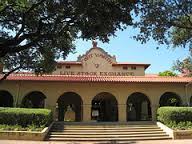
We began the morning at the Fort Worth Stockyards Museum located in the historic and beautiful Fort Worth Livestock Exchange Building. Admission is $2.00. The museum is operated by the North Fort Worth Historical Society. Quaint is perhaps the best way to describe the museum. The museum appeared to be operated by volunteers. If they were paid it was apparent they still loved the Yards and were committed to their work.  I asked one of the persons on duty, given parts of the historic stockyards were being redeveloped, what was going to happen to the Exchange Building? He told me there were no plans to demolish it, but if they tried to he would chain himself to the building. I took this as no idle threat from a very feisty seventy-five-year-old cowboy.

The museum occupied what had previously been two offices on the first floor of the building. One side was all displays and the other divided into gift shop and very makeshift “theatre.”

The museum that resembled many County Historical museums that can be found in rural South Dakota was a series of displays of photographs, newspaper articles, and collections from businesses or individuals that had been associated with the Stockyards over the years. There were extensive photographs of many aspects of the Swift & Armour packing plants. Ditto for memorabilia from many commission companies that operated at the yards.

There was nothing extraordinary to see. The displays only reinforced my understanding and experience of the Stockyards. My family had a strong connection to the Fort Worth Stockyards. My Great Grandfather had been a livestock buyer there for a few years prior to 1910. My Grandfather was a drover there for his father from 1908 until 1910 and then bought cattle and sheep at the Yards from 1910 until 1961. My Father drove a rendering truck and picked up dead animals at the Stockyards in the mid-1930s. The Stockyards at their zenith, had 10 million bricks for paving and covered more than 100 acres.

In the theatre area that included six folding chairs, the film the Historical Society produced , “Wall Street of the West”, is played throughout the day. The film is an excellent history of the Stockyards and its importance. The primary thing the Stockyards Museum had going for it is its location.  The Fort Worth Stockyards is listed on the National Register of Historic Places. Consequently, it is a major tourist attraction, attracting 500,000 visitors each year.


Lunch was at Railhead Smokehouse. Repeating our Angelo’s order from Saturday, two sliced brisket sandwiches and ribs. A Plus. The brisket certainly equals Angelo’s and the ribs are better. For some time, I have preferred Railhead to the aging Angelo’s. This trip the difference was well defined.


After lunch, we headed to Hebrew Rest cemetery on South Main for me to check out a grave site while Harry double parked at John Peter Smith Hospital. Then it was off to DFW for the trip home. It was another great trip with my boy.